
Reviewed · TEMPLE & ALMSGIVING TOURS
Luang Prabang: Almsgiving Ceremony Offering
Wake before sunrise for a quieter Luang Prabang. I like that this one-hour experience gives you a traditional offering set and explains the meaning of Tak Bat, rather than leaving you to guess what to do. I also like the follow-up temple visit, which adds Buddhist context after the monks have passed. The main concern is reliability: two recent bookings reported that the guide did not appear or could not be found.
The strongest praise goes to Johnny, also spelled Jonny in some bookings, who previously spent 10 years as a monk and explains Buddhist practice with unusual first-hand insight. I would book this for the cultural guidance and simple preparation, but I would confirm the meeting point and guide contact before setting the alarm.
In This Review
- Key points at a glance
- What Tak Bat means in Luang Prabang
- Starting before sunrise at L’Elephant
- Receiving the Lao offering set
- Watching the monks pass through Luang Prabang
- The nearby temple after the offerings
- What the $25 price really covers
- The guide can make or break the morning
- Who should book this experience?
- Practical preparation for a respectful visit
- Should you book the Luang Prabang almsgiving ceremony?
- FAQ
- How long does the almsgiving experience last?
- Where does the experience start?
- What does the traditional offering set include?
- Is a scarf provided?
- What should I wear?
- Can I take photographs?
- Is transportation included?
- What languages are available for the live guide?
Key points at a glance
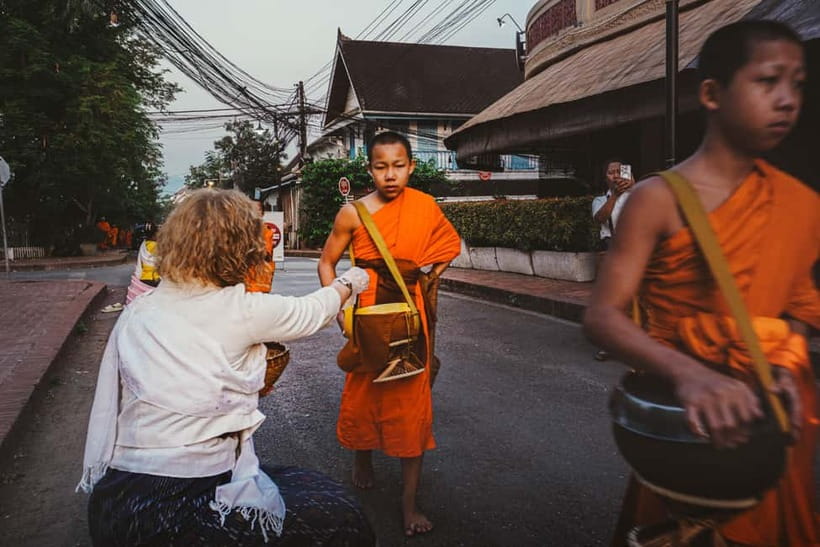
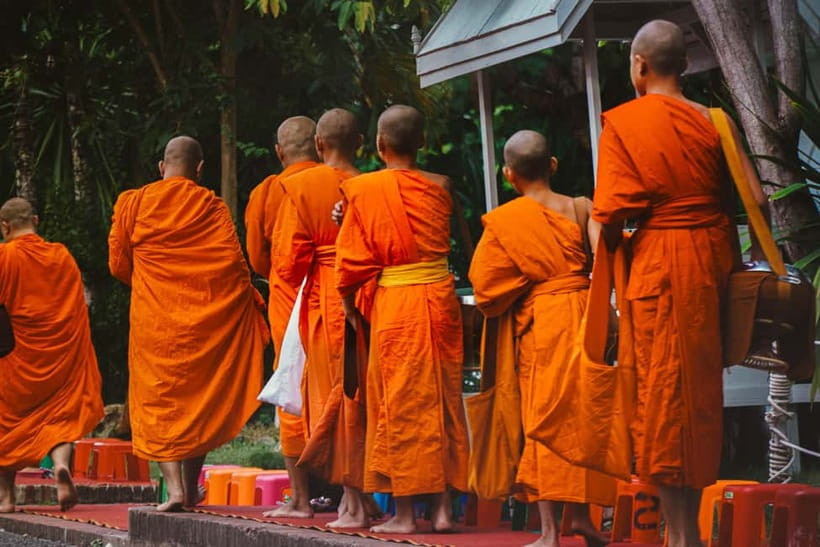
- A sunrise ritual in the old town: Tak Bat takes place in the quiet early morning, when saffron-robed monks walk silently through Luang Prabang.
- Your offering is prepared for you: The package includes sticky rice, bananas, and snacks, so you do not need to arrange food before dawn.
- A scarf is supplied: You receive a local-style scarf to wear during the ceremony, though modest clothing remains your responsibility.
- Johnny receives the highest praise: His former monastic life and clear explanations are a major reason this experience earns strong marks from many participants.
- The temple visit adds meaning: After the almsgiving, you visit a nearby temple for more insight into Buddhist customs.
- Logistics need care: Transport is not included, and the listed starting location is L’Elephant, while one recent arrangement met near Wat Nong Temple.
What Tak Bat means in Luang Prabang
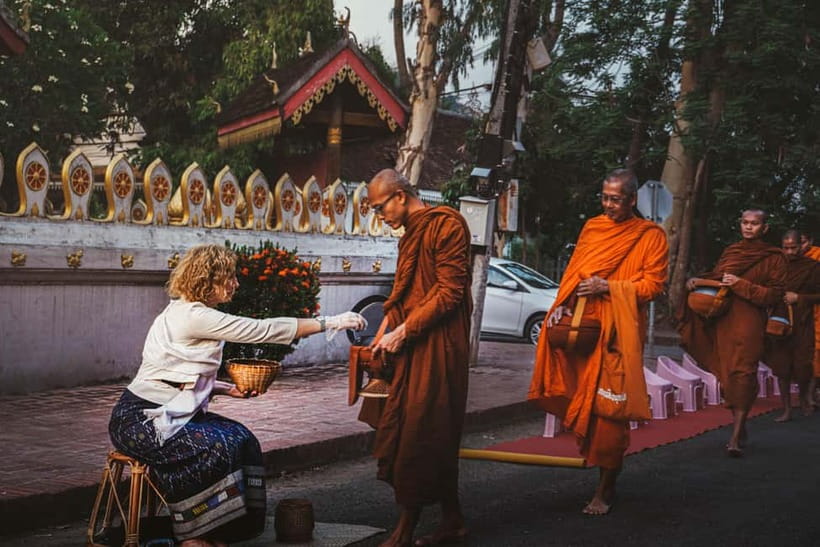
Tak Bat is Luang Prabang’s morning almsgiving ceremony. Buddhist monks walk silently through the streets while local people place food into their alms bowls. The act is simple, but it carries religious meaning for both sides: people give food as a spiritual offering, while monks receive what they need for the day.
You are not watching a staged performance. This is a daily religious practice, and that changes how you should approach it. The best experience comes from staying quiet, dressing properly, and treating the ceremony as a sacred moment rather than a photo stop.
The supplied offering set helps you take part without having to search for sticky rice or snacks in the dark. You receive traditional items including sticky rice, bananas, and other small foods. That convenience matters, especially if you are staying in Luang Prabang for only a short time and want help handling the custom correctly.
I also value the guidance on respectful behavior. You are told not to touch the monks or their alms bowls, and flash photography is not allowed. Those rules are basic, but they protect the calm mood of the ceremony and keep your participation from becoming intrusive.
Other temple visits and alms giving:
- Luang Prabang: Evening Cooking Class & Local Baci Ceremony
★ 4.9 · 151 reviews - Home-cooked dinner & Baci ceremony with Villagers in Ban Nasang
★ 5.0 · 12 reviews - Luang Prabang Early Morning Alms Giving and Wet Market
★ 4.5 · 5 reviews
Starting before sunrise at L’Elephant
The published starting location is L’Elephant, and the experience begins early enough to include sunrise views along the way. The supplied details do not give a precise departure time, so you need to check the available start times when booking.
There is an important practical wrinkle. One recent participant met the guide near Wat Nong Temple on a quiet side road, while the stated starting location is L’Elephant. These points may reflect a meeting arrangement that changes, but you should not assume one is correct without checking. Confirm the exact place, time, and contact details before you go to bed.
Transport to the ceremony spot is not included. That means you are responsible for getting to the starting point, and you should plan this carefully because the activity takes place before most of Luang Prabang has started its day. If you are staying outside the central area, ask about the route and allow enough time to arrive without rushing.
The early hour is part of the appeal. Luang Prabang can feel particularly calm at dawn, and the soft light makes the old town a fitting setting for a quiet religious ritual. Still, this is not a late-morning sightseeing activity. If you dislike early starts, the one-hour schedule may feel demanding for a relatively short outing.
Receiving the Lao offering set
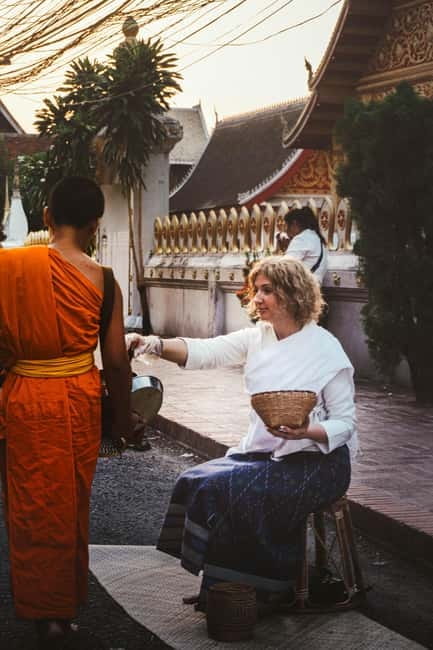
Once you meet the guide, you receive the traditional Lao offering set. The listed items are sticky rice, bananas, and snacks. This is a useful part of the $25 price because it lets you participate without buying or preparing offerings separately.
The food is not simply a souvenir or prop. You place it into the monks’ bowls as they pass. The ceremony works best when you move slowly, stay focused, and follow the guidance provided. The goal is not to fill a bowl as quickly as possible or compete for the best photograph.
A local-style scarf is included for use during the ceremony. It helps you dress in a way that fits the setting, but it does not replace the need for suitable clothes. You should arrive with your shoulders and knees covered. Bring an extra scarf if you prefer to have your own, since the activity also lists a scarf among the suggested items to bring.
The offering set makes this experience more approachable for first-time visitors. Without it, you might stand at the edge of the street unsure how to participate. With it, you can take part directly while receiving basic instruction about the custom.
Watching the monks pass through Luang Prabang
The heart of the activity is the procession of saffron-robed monks. They walk silently through the streets, collecting food from people seated or standing along the route. You join the line of people making offerings and place the food into the alms bowls as the monks pass.
This is where the guide’s role matters most. The description says guidance on respectful behavior and traditions is included, while the activity information also says a step-by-step explanatory guide is not included. I would interpret that as basic assistance rather than a long lecture during the procession. Expect help with the custom, but save detailed questions for the quieter temple visit afterward.
Johnny receives especially strong praise for explaining Buddhism, the monastic tradition, and the ceremony. Several bookings describe him as professional, clear, and easy to talk with. One German participant specifically appreciated that he had spent 10 years as a monk. That background could give the experience more depth than a quick set of instructions from someone who knows only the tourist routine.
A few practical rules make a big difference:
- Keep your voice low.
- Do not touch monks or their alms bowls.
- Do not use flash photography.
- Dress with shoulders and knees covered.
- Follow the guide’s instructions when placing food in the bowls.
The ceremony is a poor fit if your main goal is unrestricted photography. You can bring a camera, but the no-flash rule and the sacred nature of the event should shape how you use it. The best pictures will likely be quiet, respectful images taken without interrupting the procession.
A few more Luang Prabang trips worth reading about
- Luang Prabang: Cruise to Pak Ou Caves & Kuang Si Waterfalls
★ 5.0 · 1,769 reviews - Luang Prabang: Cruise to Pak Ou Caves & Kuang Si Waterfalls
★ 4.8 · 1,360 reviews - Half Day Mekong Cruise to Pak Ou Caves (Morning / Afternoon)
★ 4.6 · 290 reviews - Luang Prabang: UNESCO World Heritage City Highlights Tour
★ 4.6 · 201 reviews
The nearby temple after the offerings
After the almsgiving, you visit a nearby temple for a closer look at Buddhist practice. This second part is important because the ceremony itself can pass quickly. The temple gives you time to ask questions and connect the offering ritual with the wider religious life of Luang Prabang.
The supplied details do not name the temple as part of the formal itinerary, but one recent arrangement met by Wat Nong Temple. You should confirm the exact temple before booking if the name matters to you. In any case, the visit is intended to provide deeper insight rather than simply another sightseeing stop.
I like this structure: first you watch and participate, then you receive context. It is easier to understand the meaning of Tak Bat after you have seen the monks walk through the streets and taken part in the offering yourself.
Do not expect a full temple tour lasting several hours. The total activity lasts one hour, including the ceremony, sunrise scenery, and temple visit. The temple stop is best viewed as a focused introduction to Buddhist customs, not a complete religious studies lesson.
What the $25 price really covers
At $25 per person, this is not the cheapest way to stand along the almsgiving route. You could observe the ceremony independently, and Luang Prabang offers plenty of opportunities to see monks pass through the old town.
The value comes from the parts that are harder to arrange on your own. You receive food for the offering, a scarf, instruction on respectful behavior, and a temple visit. You also gain a point of contact for questions about Buddhist practice. If Johnny leads your session, his former monastic experience adds a level of personal insight that is difficult to replicate with a quick internet search.
The price is less attractive if you only want photographs or a brief look at the procession. It is also less convenient if you expect transfers, since transportation to the spot is not included. You are paying mainly for preparation, participation, and cultural explanation, not for a long sightseeing program.
The overall rating is 4.1 from 13 ratings, which points to a generally positive experience with a clear service concern. Most of the detailed praise centers on the guide and the quality of the explanations. Two one-star bookings report a no-show or difficulty locating the guide, so I would treat meeting arrangements as a serious part of the value calculation.
The guide can make or break the morning
The difference between a meaningful ceremony and a confusing one often comes down to the guide. The strongest comments praise Johnny or Jonny for explaining Buddhism and monastic life in a clear, friendly way. His 10 years as a monk are particularly relevant here because he can speak about the practice from personal experience.
Several people also appreciated the close contact with the organizer and other participants. That suggests the experience can feel personal rather than like a large crowd gathered around a guide with a flag. However, no group-size figure is provided, so you should not assume the group will be tiny.
The negative reports deserve equal attention. One person said the guide did not show up. Another said the guide could not be found and there was no contact, leaving the participant to walk alone after paying. These are not minor complaints when the activity depends on meeting before sunrise.
My advice is simple: save the provider’s contact information, confirm the meeting point on the previous day, and arrive with a little time to spare. If the meeting point is L’Elephant, use that unless the organizer directly tells you to go elsewhere. If you receive a message naming Wat Nong Temple or another location, keep that written confirmation.
Who should book this experience?
I would recommend it to you if you want to participate in Tak Bat but do not want to guess at the proper etiquette. It suits first-time visitors who value cultural context, practical guidance, and a short morning activity rather than a full-day tour.
It is also a good match for photographers who can work quietly and without flash. The sunrise setting and calm streets should offer attractive images, but the ceremony must come first. If you need unlimited close-up shots, choose ordinary sightseeing instead.
Families should check the age details carefully. Babies under one year are not considered suitable for the activity. The experience is wheelchair accessible, which may help some visitors, but the supplied information does not describe the exact street surface or movement between stops, so you may want to confirm those details before booking.
The activity is listed as unsuitable for people with altitude sickness. Luang Prabang is not generally associated with high-altitude sightseeing in the way mountain destinations are, but this restriction is part of the stated conditions and should not be ignored.
You should skip it if you dislike dawn starts, cannot dress modestly, or want a completely self-directed visit. You should also think twice if you cannot confirm the meeting details, given the two reports of guide problems.
Practical preparation for a respectful visit
Wear clothing that covers your shoulders and knees before you leave your accommodation. Do not count on the supplied scarf alone to solve every clothing issue.
Bring a camera if you want to record the quiet streets and sunrise, but keep the flash switched off. You should also be prepared to put the camera away during the most sensitive parts of the ceremony. A respectful memory is more valuable than a hurried picture taken at the wrong moment.
You do not need to arrange sticky rice, bananas, or snacks in advance because the offering set is included. You also do not need to bring a special scarf, though bringing one is listed as a suggestion and may give you a preferred option.
The tour lasts one hour, so keep your expectations focused. You will see the almsgiving, take part with the provided food, enjoy scenic views connected with sunrise, and visit a nearby temple. You will not receive an all-day exploration of Luang Prabang’s temples and Buddhist traditions.
English and Thai guiding are available. If the guide is Johnny or Jonny, ask questions about the monastic tradition after the procession, when conversation is more appropriate. That is likely where the experience offers its greatest educational value.
Should you book the Luang Prabang almsgiving ceremony?
Book it if you want a guided, respectful introduction to Tak Bat, especially if you value the included offering set and a guide who can explain Buddhist practice. The one-hour format is easy to fit into a Luang Prabang itinerary, and the temple visit gives the morning more substance than simply watching monks pass.
I would not book it blindly. Confirm the meeting location, check the guide contact, and understand that transport is not included. The strong praise for Johnny makes the experience appealing, but the two no-show complaints mean the organizer needs to get the basic logistics right.
At $25, the experience offers fair value for a prepared offering, scarf, cultural guidance, and temple stop. If those elements matter to you, it is a worthwhile way to meet Luang Prabang at dawn. If you only want to observe the ceremony, you may prefer to go independently and spend the money elsewhere.
FAQ
How long does the almsgiving experience last?
The activity lasts one hour.
Where does the experience start?
The stated starting location is L’Elephant in Luang Prabang. A recent arrangement met near Wat Nong Temple, so confirm the exact meeting point before attending.
What does the traditional offering set include?
The offering set includes sticky rice, bananas, and snacks.
Is a scarf provided?
Yes. A local-style scarf is provided for you to wear during the ceremony. A scarf is also listed among the suggested items to bring.
What should I wear?
You should dress modestly, with your shoulders and knees covered.
Can I take photographs?
You may bring a camera, but flash photography is not allowed. You must also avoid touching the monks or their alms bowls.
Is transportation included?
No. Transportation to the ceremony spot is not included.
What languages are available for the live guide?
Live guiding is available in English and Thai.
Fresh in Luang Prabang
- 6-Day Private Laos Tour to Vientiane, Pak Ou Cave, Luang Prabang★ 5.0 · 5 reviews
- The Namkhan – Traditional Lao Bamboo Weaving★ 5.0 · 4 reviews
- The Namkhan – Yoga Class (8 am or 4 pm)★ 4.0 · 5 reviews
- Unwind with a Sunset Cruise on the Mekong River★ 5.0 · 4 reviews
- Night Bus to Huay Xai, Chiang Rai, Thailand – Hotel pickup★ 3.0 · 2 reviews
- Sunset Cruise in Luang Prabang with Live Performance★ 4.5 · 3 reviews
- Private Tour: Half-Day City Tour of Luang Prabang★ 4.5 · 4 reviews
- Private Luang Prabang City Tour★ 5.0 · 3 reviews
Temple & Almsgiving Tours, compared.
Mystic Falls & Timeless Temples of Southern Laos Tour
Read our review →
Home-cooked dinner & Baci ceremony with Villagers in Ban Nasang
Read our review →

Luang Prabang Early Morning Alms Giving and Wet Market
Read our review →Browse the lists this tour appears in