
Reviewed · MEKONG RIVER CRUISES
Luang Prabang: Mekong Meals Food Tour with 15+ Tastings
The best Lao meal may be served beside a market. This four-hour walking feast moves through Luang Prabang for 15 or more tastings, from grilled fish and Lao sausage to noodles, papaya salad, and sticky rice. I like the wide range of settings, and I like having a local guide explain what you are eating instead of leaving you to guess at unfamiliar stalls.
The small group, limited to eight people, also makes a difference. Guides such as Mr Nan, Mr Toun, Tun, Latda, and Ad have been praised for their friendly explanations of Lao food, customs, and local life. The main consideration is that this is not a tidy restaurant crawl. Portions can add up quickly, the food is very local, and the temple visit with a monk may not suit everyone.
In This Review
- Key points at a glance
- Starting at Khaiphaen in the old city
- The first bites: riverweed, mushrooms, and coal-roasted rice
- Meeting a monk at the temple
- Grilled fish beside the Mekong at sunset
- Seven or eight stops through Luang Prabang after dark
- The night markets and the final noodle bowl
- What the guide adds to the meal
- Is $45 a fair price?
- Dietary limits and comfort
- Who should book this food tour?
- Should you book the Mekong Meals Food Tour?
- FAQ
- How long does the Luang Prabang food tour last?
- How many food tastings are included?
- What kinds of food might I try?
- Is a drink included?
- Where does the tour start?
- Where does the tour finish?
- Is the tour suitable for vegetarians or vegans?
- Can people with gluten intolerance or allergies join?
- What should I bring?
Key points at a glance
- Seven to eight stops over four hours: You move between restaurants, street stalls, markets, and riverside eateries rather than sitting in one place.
- A serious amount of food: Expect 15 or more tastings, with local drinks, bottled water, and a Beerlao included.
- A monk conversation and blessing: You may ask questions about monastic life through your guide, but the religious element deserves advance notice.
- A sunset Mekong stop: Pun pa grilled fish arrives with fresh herbs and vegetables beside the river.
- A very small group: The usual limit is eight participants, which helps when ordering, walking, and asking questions.
- Best for adventurous eaters: Vegetarian, vegan, pregnant, wheelchair-using, and severely allergic diners should choose another experience.
Starting at Khaiphaen in the old city
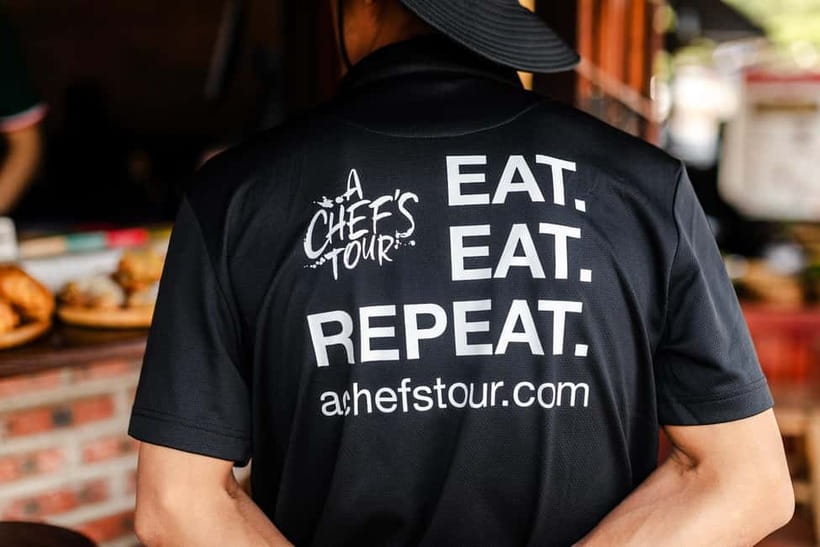
The evening begins outside Khaiphaen Restaurant, across from Wat Choum Khong Sourin Tharame. Look for a guide wearing a black A Chef’s Tour polo shirt. This is an easy central meeting point, and you can reach it from most hotels in Luang Prabang without a hotel transfer.
That central start matters. Luang Prabang’s old city is compact, but its food life is spread through lanes, markets, small restaurants, and riverside stops. The tour uses the town as its dining room, so comfortable shoes are more useful than smart clothes.
You start with a guide who helps you read the evening. That may mean explaining ingredients, pointing out how herbs are used, or giving context about Lao food and the different groups who live in Laos. The strongest part of this tour is not simply the number of plates. It is the help you receive in deciding what each dish is, how it is eaten, and why it belongs on the table.
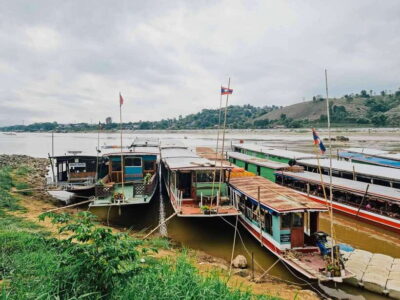
Other slow boats along the Mekong:
- Half Day Mekong Cruise to Pak Ou Caves (Morning / Afternoon)
★ 4.6 · 290 reviews - Chiang Rai: 2-Day Transfer to Luang Prabang by Slow Boat
★ 3.7 · 149 reviews - FULL DAY – Kuang Si Waterfall, Kayak on the Nam Ou / Mekong River, Pak Ou Caves
★ 5.0 · 81 reviews
The first bites: riverweed, mushrooms, and coal-roasted rice
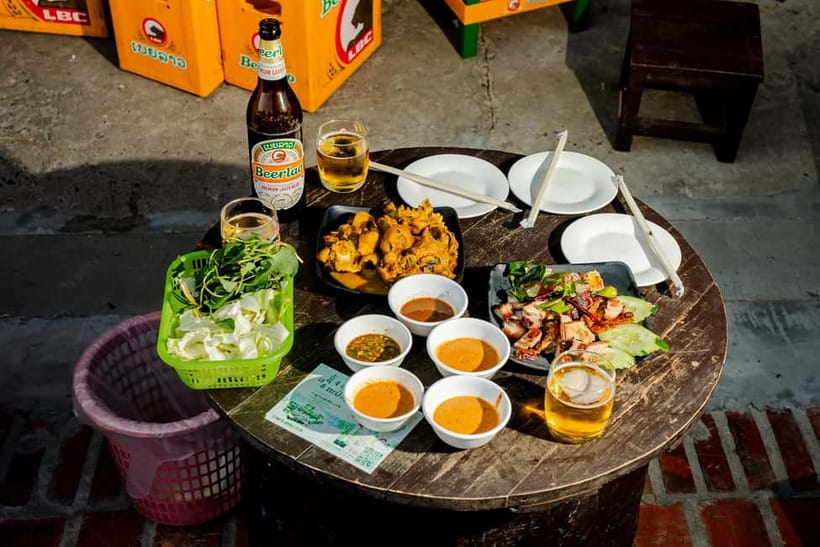
Early tastings introduce you to flavors that can be easy to miss if you stick to restaurant menus. Riverweed crackers bring a crisp snack linked to the Mekong, while Hmong mushroom dip gives you a taste of a more earthy, herb-led style of Lao cooking.
You may also try sticky rice roasted over hot coals. Sticky rice is central to eating in Laos, and this version shows how a basic staple can become a snack with smoke and texture. These first stops are useful because they give you a few reference points before the larger dishes arrive.
The exact order of food can change. One noodle stop has occasionally sold out before the group reached it, but the tour has enough other stops to keep the meal moving. That is part of the street-food bargain: you get food at its freshest, but a small vendor may run out.
Meeting a monk at the temple
One unusual part of the evening is a stop at a local temple, where a saffron-robed monk may invite the group for an open conversation. Through the guide, you can ask about the monk’s lifestyle and daily routine. A short blessing follows.
For many people, this is the most memorable cultural moment of the night. It offers direct contact with a part of Luang Prabang life that food alone cannot explain. The guide can translate questions and help the conversation make sense, which is especially useful if you have little background in Lao Buddhist traditions.
I would treat this section as a cultural visit, not a performance arranged only for photos. Dress respectfully, with shoulders and knees covered if possible. You should also know that one person strongly disliked being included in a prayer service without clearer warning. If you do not want to take part in a religious blessing, ask about the format before booking.
The temple visit is also why the tour is not ideal for every type of visitor. It may feel like an unexpected addition if you signed up only for food. For others, the monk conversation is precisely what makes the evening different from a standard tasting route.
Grilled fish beside the Mekong at sunset
After the temple stop, you walk toward the Mekong, with a short tuk-tuk ride used near the end of the route. The ride is brief, but it adds a pleasant change of pace and gives you a small taste of moving around town the local way.
At the river, look for pun pa, grilled fish served with a bundle of fresh herbs and vegetables. This is one of the more atmospheric stops because the meal arrives as the sun goes down and the riverside begins to cool. The herbs matter. Lao food often depends on freshness, sharpness, and contrast, not just heat.
This stop is also a good reminder that the tour is about ordinary local eating rather than formal dining. You are not being taken to a polished tasting counter with carefully measured bites. You are eating in places where the setting, timing, and available dishes can change.
A few more Luang Prabang trips worth reading about
- Luang Prabang Evening Food Tour by Tuk-Tuk
★ 4.5 · 68 reviews - Mekong Meals Food Tour with 15+ Tastings
★ 5.0 · 37 reviews - Luang Prabang: Mekong Sunset Cruise & Lao Tasting Dinner
★ 4.3 · 27 reviews - Luang Prabang Plates Food Tour with 15+ Tastings
★ 5.0 · 21 reviews
Seven or eight stops through Luang Prabang after dark
The route continues through markets, streetside stalls, local eateries, and older family-run vendors. Some vendors have been serving food for generations. The tour’s moveable format lets you try several small specialties without committing an entire meal to one unfamiliar dish.
Expect a broad mix that can include:
- Herb-packed Lao sausage
- Piquant papaya salad
- Beef platters
- Lemongrass pork
- Sticky rice
- Khao piak sen, a hot Lao noodle soup
- Riverweed crackers
- Hmong-style mushroom dip
- Pun pa grilled fish with herbs
- Other seasonal or vendor-specific tastings
Lemongrass pork was a particular favorite for one diner, while others praised the noodle soup, grilled fish, and overall range. You may not love every bite. That is part of the point. A food tour should show you what local people eat, not assemble ten safe dishes chosen to please every palate.
The food is often served in shared portions. Although the route promises 15 or more tastings, some are combined at the same stall or restaurant. One person counted closer to 10 dishes, while another counted about 14 or 15. In practical terms, you will taste a great deal of food, but the number depends on how you count each component.
The night markets and the final noodle bowl
The night markets add color and movement without turning the evening into a shopping trip. You walk through the stalls while the guide points out foods you might otherwise pass without understanding. This is where a guide earns the cost of the tour. A menu may tell you the name of a dish, but it rarely explains which sauces to use, how sticky rice is handled, or which flavors are common in the region.
A steamy bowl of khao piak sen can arrive late in the route. It is a comforting dish, but by then you may already be full. Several people found the quantity generous enough that they could manage only a few bites of some dishes. That is a good reason to arrive genuinely hungry and avoid a large lunch on the same day.
If a vendor is sold out, the route may substitute another tasting. This flexibility is normal for street food and should not be mistaken for poor planning. The tradeoff is simple: you get food from active local stalls, but you do not get the fixed menu of a restaurant.
What the guide adds to the meal
The guide is the thread holding the evening together. A good guide explains the food, translates questions, manages the walking route, and helps the group order without confusion. The guides named in the feedback, including Mr Nan, Mr Toun, Tun, Latda, Sack, and Ad, were repeatedly praised for being warm, clear, and helpful.
Mr Nan was also appreciated for taking group photos and sharing them promptly. Ad helped one person buy extra food after the tour. These are small details, but they show the kind of practical assistance you can receive when the guide is engaged with the group.
The cultural explanations can reach beyond food. One evening guide discussed different subgroups in Laos, along with traditional ingredients and eating habits. If you enjoy asking questions, this is more than a checklist of snacks. If you prefer to eat quietly and move fast, the explanations may occasionally slow the pace.
English is the tour language. The small group size, with a limit of eight, gives you a better chance to ask about ingredients and request clarification than you would on a large coach-style excursion.
Is $45 a fair price?
At $45 per person, this is not the cheapest way to eat in Luang Prabang. You could spend much less by ordering one or two dishes at a market. But the price includes 15 or more tastings, seven to eight food stops, bottled water, local drinks, and a Beerlao, along with four hours of guiding.
You are also paying for access and confidence. Without a guide, you might recognize a few dishes but miss how the meal fits together. You might not know which stall to trust, how to order, or where to find foods outside the main tourist streets. The guide also handles the route, translations, and the short tuk-tuk transfer.
The value is strongest if this is your first visit to Luang Prabang or your first real introduction to Lao cuisine. One useful strategy is to book it near the start of your stay. You can note the dishes you like, then return to some of the same restaurants or order similar food later. This turns the tour into both dinner and a practical orientation.
The price is less appealing if you eat very little, dislike shared portions, or want a quiet sit-down meal. You may also find that the amount of food is almost excessive. Smaller portions would make it easier to sample everything, though the current format does ensure that you do not leave hungry.
Dietary limits and comfort
This is a meat-focused route. It is not suitable for vegans or vegetarians, and a vegetarian version would have four or five fewer tastings because alternatives are limited. Pregnant women are also listed as unsuitable for the experience.
People with mild gluten intolerance may be able to take part, but the tour is not suitable for celiac disease. Three or four tastings contain traces of gluten or unavoidable soy sauce, and cross-contamination is possible. Severe allergies are not suitable for this tour for the same reason.
The walking pace is described as easy, but you still need to spend much of four hours on your feet. Wear comfortable shoes. The tour operates in rain or shine, with most eating stops sheltered, so carry an umbrella or rain gear if the forecast looks uncertain.
Hotel pickup and drop-off are not included. You finish at the Tourist Information Center at Machi-Zukuri Community, a useful central location for continuing your evening on foot.
Who should book this food tour?
I would choose this experience if you want a broad first taste of Luang Prabang and are happy to let someone else make the food decisions. It suits curious eaters who want grilled meats, herbs, noodles, dips, rice, and market snacks rather than a polished Western-style meal.
It is also a good fit if you enjoy cultural conversation. The monk visit, temple blessing, local history, and explanations of Lao communities give the night more shape than a simple list of dishes.
I would skip it if you need strict control over ingredients, avoid meat, dislike religious visits, or prefer to choose every dish yourself. You should also think twice if four hours of eating sounds excessive. This is a generous meal, and you may be full well before the final stop.
Should you book the Mekong Meals Food Tour?
For most first-time visitors who eat meat and want an efficient introduction to Lao food, I think $45 is a fair price. The small group, wide food range, sunset Mekong stop, and capable English-speaking guides give you much more than a collection of samples.
Book it early in your Luang Prabang stay so you can return to favorite dishes later. Wear respectful clothing for the temple, arrive hungry, and ask about the blessing if that matters to you. If those points work for your plans, this is a lively, useful way to meet the city after dark.
FAQ
How long does the Luang Prabang food tour last?
The experience lasts four hours, including walking, food stops, the temple visit, and a short tuk-tuk ride.
How many food tastings are included?
The tour includes 15 or more tastings, spread across seven to eight stops. Some tastings may be served together at the same restaurant or stall.
What kinds of food might I try?
Possible tastings include riverweed crackers, Hmong mushroom dip, sticky rice roasted over coals, Lao sausage, papaya salad, beef, lemongrass pork, grilled fish, and khao piak sen noodles.
Is a drink included?
Yes. Bottled water, local drinks, and one Beerlao are included. Other alcoholic drinks cost extra.
Where does the tour start?
It starts outside Khaiphaen Restaurant in Luang Prabang’s old city, across from Wat Choum Khong Sourin Tharame. The guide wears a black A Chef’s Tour polo shirt.
Where does the tour finish?
The tour ends at the Tourist Information Center at Machi-Zukuri Community.
Is the tour suitable for vegetarians or vegans?
No. The experience is not suitable for vegetarians or vegans because there are limited alternatives and several tastings would be missed.
Can people with gluten intolerance or allergies join?
Mild gluten intolerance may be manageable, but the tour is not suitable for people with celiac disease or severe allergies because of traces, soy sauce, and cross-contamination risks.
What should I bring?
Bring comfortable shoes and clothing suited to the weather. Carry an umbrella or rain gear because the tour runs in wet weather, with some walking between sheltered food stops.
More Food in Luang Prabang
- Luang Prabang: Foodie Walking Tour & Monk Blessing
★ 4.7 · 66 reviews - Prabang Plates Food Tour with 15+ Tastings
★ 5.0 · 15 reviews - Luang Prabang Street Food Culture, Paper Handicraft Village Tour
★ 5.0 · 10 reviews - Luang Prabang Foodie Walking Tour and Monk Blessing
★ 5.0 · 7 reviews
Fresh in Luang Prabang
- 6-Day Private Laos Tour to Vientiane, Pak Ou Cave, Luang Prabang★ 5.0 · 5 reviews
- Unwind with a Sunset Cruise on the Mekong River★ 5.0 · 4 reviews
- The Namkhan – Traditional Lao Bamboo Weaving★ 5.0 · 4 reviews
- The Namkhan – Yoga Class (8 am or 4 pm)★ 4.0 · 5 reviews
- Night Bus to Huay Xai, Chiang Rai, Thailand – Hotel pickup★ 3.0 · 2 reviews
- Sunset Cruise in Luang Prabang with Live Performance★ 4.5 · 3 reviews
- Private Tour: Half-Day City Tour of Luang Prabang★ 4.5 · 4 reviews
- Private Luang Prabang City Tour★ 5.0 · 3 reviews
Mekong River Cruises, compared.
Half Day Mekong Cruise to Pak Ou Caves (Morning / Afternoon)
Read our review →
FULL DAY – Kuang Si Waterfall, Kayak on the Nam Ou / Mekong River, Pak Ou Caves
Read our review →
Nong Khiaw to Luang Prabang, Mekong & Nam Ou River Cruise
Read our review →

Browse the lists this tour appears in